
Science Gallery Network
Bringing science, art, technology and design together, Science Gallery delivers unique, transdisciplinary exhibitions, events and educational programmes that engage millions of inquiring minds every year in connective, participative, and surprising ways.
The Science Gallery Network is an international collaboration of leading universities dedicated to public engagement through interdisciplinary art-science initiatives. As a Network, we seek to change the world through youth-led perspectives, igniting conversations and collaborations, and support young people to find connection, hope and agency through curiosity and creativity. We will achieve this as a global platform with a critical mass of public venues and digital spaces engaging millions of people.
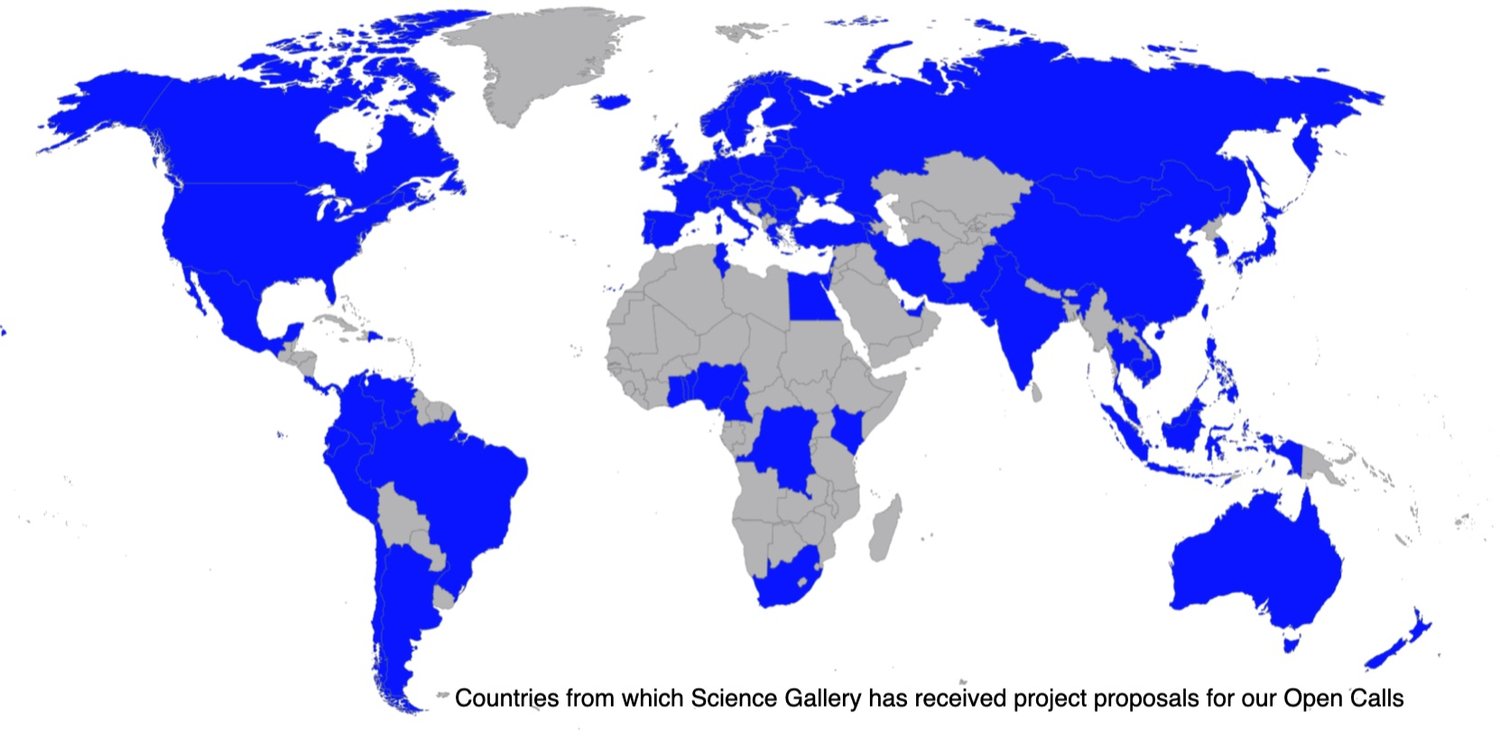
Open calls
Each open call runs for 5 - 6 weeks. Ready your submission at least a few days before the deadline to ensure you have no technical difficulties and can have any queries answered in advance. The submission form closes automatically on the last day, and late submissions will not be accepted.
Most open C lls are run by individual locations in the Network (Atlanta, Bengaluru, Berlin, Dublin, London, Melbourne and Monterrey). Be sure to reach out directly to the correct location that has launched the call for any queries about their process. If the call is run by multiple locations simultaneously, a specific contact will be provided on the call page. Contact information for questions can always be found on an individual Open Call page. Review process dates are clearly published, and results are communicated shortly thereafter.
Technical difficulties with the application forms should be addressed to Submittable directly.
What does it mean to measure something? What roles do observation and measurement play in determining what can be known about a quantum system? And what can we say about possibilities that are not observed?
Science Gallery Bengaluru invites emerging curators and curatorial collectives of Indian nationality, based in India, to apply for our inaugural Curatorial Fellowship, as part of QUANTUM. Artists, researchers, and cultural practitioners with interdisciplinary practice are also eligible to apply.
The fellowship offers an opportunity to develop a companion exhibition in response to QUANTUM. We are looking for practitioners working across disciplines, forms of knowledge, and practices, and interested in developing a curatorial proposition through research and collaboration..
The selected fellow will be mentored by interdisciplinary artist Moonis Ahmad Shah, whose practice moves across installation, sculpture, and computer programming. The mentorship will involve conceptual dialogue, feedback, and discussion throughout the development of the curation.
The fellow will have access to the QUANTUM exhibition and relevant research materials, as well as opportunities to engage with artists and researchers involved in the exhibition. They will also work with the Science Gallery Bengaluru curatorial and programmes teams and, where appropriate, relevant researchers and subject experts.
We are interested in proposals that use quantum physics as a starting point for developing new questions and connections across disciplines. These might consider observation and measurement, uncertainty and probability, histories of scientific discovery, computation and information, quantum technologies, or relationships between quantum physics and other forms of knowledge and practice.
The fellow may work with existing works, research, archives, or practices, and may commission new artworks as part of the exhibition. New commissions and production are to be developed within the available budget, however, independent streams of funding will not be discouraged provided they fall within our guidelines.
The companion exhibition will be presented in a designated gallery space at Science Gallery Bengaluru, accompanied by a public programme. The fellow will be responsible for developing the curatorial proposition and implement the installation of the exhibition at Science Gallery Bengaluru.
The fellowship will run from November 2026 to March 2027, with the companion exhibition opening in June 2027.
What makes a strong proposal?
We are looking for proposals that:
● have a clear and considered curatorial proposition;
● demonstrate experience working across disciplines, practices, or forms of knowledge;
● engage meaningfully with the questions raised by QUANTUM;
● demonstrate an ability or willingness to develop an exhibition through research and collaboration; and
● are feasible within the available resources and timeline.
We are particularly interested in practitioners who are still developing their curatorial approach and would benefit from sustained mentorship. Applicants may come from curatorial, artistic, research, or other interdisciplinary backgrounds, and should demonstrate previous work, projects, or experiences that speak to their ability to develop ideas through research, collaboration, or engagement across disciplines.
What should I submit?
1. Curatorial proposal — 500 words
Your proposal should outline the curatorial proposition for the companion exhibition and accompanying public programme, including the questions it will explore, its relationship to QUANTUM, and the kinds of works, practices, research, or contributors it might bring together. You may also indicate any new commissions you are considering.
The proposal does not need to be a fully resolved exhibition plan. We are interested in your curatorial thinking, point of view, and the connections you see between QUANTUM and the proposition you are developing.
Please review QUANTUM before responding to this prompt: https://quantum.scigalleryblr.org/exhibition
2. CV
Please submit a current CV
3. Statement of Purpose
Please share a statement outlining your approach to curation and the ideas that inform your understanding of the curatorial process. We are interested in how you think about the what, how, and why of curation — the questions you believe curation can ask, the kinds of relationships it can create, and the ways you imagine working with artists, ideas, audiences, and contexts.
You do not need to have previous curatorial experience to respond to this prompt. You may draw on your experiences across art, culture, research, or other fields, as well as projects or encounters that have shaped your understanding of what curation can be.
4. Two references
Please provide the name, email address, phone number, and relationship to the applicant for two referees.
5. Indicative budget
If your proposal involves new commissions or significant production, please briefly indicate how you anticipate using the available budget.
Fellowship support
The selected fellow will receive a curatorial fee of ₹60,000 and a production budget of up to ₹2,00,000. The production budget can be used towards artist fees, commissions, fabrication, materials, and other production requirements for the companion exhibition.
Timeline
Open Call: 27 September – 27 October 2026
Interviews: 6–7 November 2026
Fellowship: November 2026 – March 2027
Production & Installation: April – June 2027
Showcase: 5 June – 7 August 2027
About QUANTUM
QUANTUM is Science Gallery Bengaluru's current exhibition-season, exploring questions around measurement, observation, uncertainty, possibility, and the nature of reality.
Bringing together artists, scientists, researchers, and other practitioners, QUANTUM considers quantum physics through multiple forms of inquiry and asks how ideas emerging from quantum science might connect to the ways we understand knowledge, matter, technology, and the world around us.
QUANTUM launched on 8 August 2026 and runs until August 2027.
About the Mentor
Moonis Ahmad Shah is a visual artist whose practice moves across installation, sculpture, and computer programming. His work explores the emergence of counter-worlds and relationships between physical, technological, and imagined environments.
About SGB
Science Gallery Bengaluru (SGB) is a public institution for research-based engagement at the interface between the human, social and natural sciences, and engineering, art and design. We do so through Living Exhibitions, Public Engagement Programmes, Mentorship Initiative, and a pioneering Public Lab Complex. Our founding partner is the Government of Karnataka. We also draw on the intellectual capital of three of India’s leading research institutions: the Indian Institute of Science is our lead academic partner, and the National Centre for Biological Sciences, and International Centre for Theoretical Sciences are our collaborating academic partners.
Science Gallery Bengaluru is Asia's first, India’s only, and the world’s largest member of the Global Science Gallery Network with sister galleries in London, Melbourne, and Monterrey. We are the only free-standing gallery in the network, located outside the walls of a university.
Questions?
For any queries regarding the open call, please contact us at:
programmes@bengaluru.sciencegallery.com
Science Gallery Bengaluru, in collaboration with Bangalore International Centre, is pleased to announce the QUANTUM Film Festival. We invite filmmakers to share completed works in any language, format, or genre that explore the theme of our ongoing exhibition-season, QUANTUM.
What if something could be in two places at once? What happens when observing something changes what you see? Could two particles remain connected across vast distances?
Quantum physics has transformed how we understand the world. From the scientists and experiments that first challenged established ideas about matter and light, to today's efforts to build quantum computers, develop new forms of communication, and understand the universe, quantum science is a story of strange discoveries, failed experiments, radical ideas, and technological possibility.
Its ideas have travelled far beyond the laboratory. Superposition, entanglement, uncertainty, and the observer effect have inspired generations of filmmakers, writers, and artists to imagine parallel worlds, alternate realities, teleportation, time loops, doubles, and other strange possibilities.
This year, the QUANTUM Film Festival explores the many worlds opened up by quantum ideas, both real and imagined. We welcome films that engage with quantum science and emerging technologies, as well as works that play with questions of probability, observation, multiple realities, coincidence, uncertainty, and the unknown.
Submissions are open to independent filmmakers, amateurs, and professionals alike. Whether documentary, fiction, experimental film, animation, science fiction, horror, comedy, or something else entirely, we invite storytellers to take us somewhere unexpected.
Alongside screenings, the festival will feature conversations and public programmes that bring filmmakers, artists, researchers, and the public together to explore the strange, speculative, and very real worlds of quantum science.
Timeline
- Call opens: 20 September 2026
- Round 1 closes: 20 October 2026
- Round 2 closes: 20 November 2026
- Films Shortlist: 15 January 2027
- Film Festival: 24-25 April 2027
Venue: Bangalore International Centre
Who can submit?
We are open to national and international submissions from broadcasters, producers, filmmakers, film students, researchers, scientific organisations, NGOs, public organisations, and online channels. We accept films across all languages. For non-English films, please ensure English subtitles are provided to make the screening accessible.
Is there a screening fee?
The festival is an open public event, and there are no costs associated with submitting a film. Selected filmmakers will be offered a nominal screening fee.
When will I hear about the selection?
Shortlisted filmmakers will hear from us in January 2027. We are unable to provide feedback on individual submissions at any stage of the selection process. Directors, producers, or distributors will be contacted upon selection of their films, and any additional requests for material or publicity may be made at that time.
For any queries regarding the open call, please drop us an email at programmes@bengaluru.sciencegallery.com
About
Science Gallery Bengaluru invites filmmakers to propose an original short film for the QUANTUM Film Festival.
The commission takes its cue from QUANTUM, Science Gallery Bengaluru’s ongoing exhibition-season. Quantum physics emerged from attempts to understand light and matter, overturning some of the most basic assumptions about how the world works. A century later, its ideas continue to shape research and technology, while also spilling into cinema, literature, and popular imagination.
There are experiments that changed the course of physics, thought experiments involving cats in boxes, particles that seem to communicate across impossible distances, and technologies that promise to transform computing and communication. There are also parallel universes, time loops, teleportation, and countless other stories that have grown around quantum ideas.
We invite filmmakers to propose an original short film that responds to this territory in their own way.
The selected filmmaker will receive a commission to develop and produce the work, along with mentorship and guidance during the development process. The completed film will premiere at the QUANTUM Film Festival.
Proposals will be shortlisted based on:
- Pertinence to the subject
- Creative engagement with the film form and narrative structure
- Clarity of perspective and argument
- The filmmaker’s past work and artistic approach
- Research depth and methodological clarity
- Budgetary feasibility
Timeline
- Call opens: 20 September 2026
- Call closes: 20 October 2026
- Shortlist: 15 November 2026
- Launch: 24 April 2027
Allocation of funds
The shortlisted filmmaker will be provided with a commissioning grant of 12 Lakh INR. The funds will be allocated in three stages:
- Story Development - 25%
- Shooting on the field - 25%
- Final Cut - Post production - 50%
What happens when the world is not quite as certain as we think it is?
Quantum physics has transformed how we understand reality, challenging ideas of certainty, observation, cause and effect. Its concepts can feel strange, even counterintuitive—but they also raise questions that extend far beyond science: Can we exist in multiple possibilities? How connected are we to one another? What can we know, and what remains uncertain? How does our act of measuring change what we see?
As part of our upcoming exhibition season, QUANTUM, we invite writers aged 18–30 to respond to these questions through prose, poetry, creative nonfiction and essays.
We are interested in writing that takes inspiration from the ideas, questions and possibilities of quantum physics and finds unexpected connections with the world around us—with relationships, memory, technology, identity, society, or everyday life.
Novelist Anil Menon will provide mentorship and editorial feedback to help chosen writers develop their work. Final pieces will be published in the QUANTUM exhibition reader and presented as part of a public reading.
Timeline:
Call goes live: 27 September 2026
Call Closes: 27 October 2026
Writing workshop and Mentorship session: 14–15 and 21–22 November 2026
Public reading and Showcase: 27 December 2026
Participation Guidelines
- The deadline for submissions is 11:59 PM IST on 27 October 2026
- You must be between 18 and 30 years of age and from India to participate.
- You must be willing to travel to Bengaluru for the public showcase. Please note that we can only cover domestic travel for selected participants from within India.
- You can submit a maximum of three responses per person.
- Your submission must be in English.
- Please include the title of your work in your submission.
- Your submission can either be an Essay or in the form of Poetry.
- For Essay Submissions, Word count: 800 to 4,000 words. Choose a length that suits your story—short personal reflections, longer explorations and pieces of fiction are all welcome.
- For Poetry Submissions, Length: 10 to 60 lines. This can be one longer poem or up to three shorter poems (total not exceeding 60 lines). Style: All forms are welcome—free verse, spoken word, narrative poetry, haiku, or experimental forms.
- Entries must be submitted in .doc or .pdf file formats. The file should be named as follows: YourName_Title_IYW2026
- Text within the submission should be formatted in Calibri, size 12.
- Submissions are expected to be edited and proofread for grammatical accuracy prior to submission. We are unable to provide detailed, line-by-line edits.
- You retain all the rights to your work. By submitting your work, you will give Science Gallery Bengaluru the permission to use and publish your submission during QUANTUM, and your submission will be archived on the Science Gallery Bengaluru website.
- Your submission should not have won or placed in other competitions, or have been published in an official capacity in other magazines, exhibitions, etc.
- Selected participants must commit to participating in the mentorship sessions and to working with the Science Gallery Bengaluru editorial team on revisions to their piece for inclusion in the QUANTUM exhibition reader.
About the Mentor
ANIL MENON’s most recent work is the novel The Coincidence Plot (Simon & Schuster, 2023). It was preceded by a collection of his speculative short fiction, The Inconceivable Idea Of The Sun: Stories (Hachette, 2022). He is currently the chief editor of The Bombay Literary Magazine.
About SGB
Science Gallery Bengaluru (SGB) is India's only and Asia's first Science Gallery, a not-for-profit public institution at Sanjaynagar, Bengaluru. SGB was established with the founding support of the Government of Karnataka and academic partners Indian Institute of Science, and National Centre for Biological Sciences. Our work for research-based engagement works at the intersection of science, art, and society to engage young adults through Live Exhibitions, Public Engagement Programmes, Mentorship Initiative, and a pioneering Public Lab Complex.
Look closer. The world around you is full of tiny mysteries and quiet surprises, waiting to be noticed. QUANTUM: Through Your Eyes invites you to look at the familiar differently—to notice something strange in an ordinary moment, or something ordinary in the strange.
A shadow that doesn't seem to belong. A reflection that alters what is real. Two things that appear unexpectedly connected. A fleeting moment held still. A pattern that seems to shift as you look at it.
Quantum physics describes the behaviour of matter and light at the smallest scales, where the familiar rules of the everyday world begin to behave differently. Ideas such as superposition, entanglement, duality and measurement have changed how we understand what we see—and what it means to observe something at all.
Photography has its own connection to this world. Light interacting with the sensor of a digital camera involves quantum phenomena; every photograph is, in some way, a trace of light being observed and recorded.
QUANTUM: Through Your Eyes invites young photographers aged 18–30 from around the world to explore these ideas through photography. We are interested in what happens when you follow a thought, a feeling, an observation or a coincidence—and look at the world a little more closely.
What might Spin look like? What does it mean to Entangle? Where might you find Duality, Measure, Tunnel or Superpose?
Selected participants will be mentored by interdisciplinary artist Arpan Mukherjee, and their works will be showcased as part of Science Gallery Bengaluru's QUANTUM exhibition season.
Timeline:
Call goes live: 27 September 2026
Call closes: 27 October 2026
Mentorship session: 17 January 2027
Showcase: 14 February 2027
Prompts:
Spin
Entangle
Duality
Measure
Tunnel
Superpose
No prior knowledge of quantum physics is required. These prompts are only intended as conceptual starting points rather than literal definitions, and participants are encouraged to interpret them through their own personal, cultural, or imaginative perspectives.
Participant Guidelines:
- This call is open to photographers aged 18–30 from India only.
- You may submit up to five photographs per person.
- Your submission must be a photograph made by you.
- Photographs must meet the minimum resolution required for exhibition: 4961 × 7016 pixels, sufficient for printing at A2 size (420 × 594 mm) at 300 ppi. Photographs that do not meet this minimum specification will not be considered.
- Experimental photographic practices including multiple exposures, collage, and digital or analogue manipulation are all welcome. AI-assisted photography is permitted with disclosure, but fully AI-generated images are not eligible.
- Please submit photographs as high-quality JPEG or TIFF files. File size may vary depending on format and compression; pixel dimensions are the determining requirement.
- The photograph must not have previously won or placed in another competition, or been published in an official capacity in magazines, exhibitions, or similar platforms.
- Each photograph must be accompanied by a 50–150 word description or caption in English. If your submission is in another language, please include an English translation. Photographs without supporting text will not be considered.
- Please include a brief bio of 50–150 words. This may be written in any language, but should be accompanied by an English translation.
- You must own the rights to the work you submit. Any copyright violations or issues concerning permissions may result in disqualification.
- If your photograph includes children, you must have secured permission from the child's parent or legal guardian to photograph and submit the work.
- Any conflicts, issues, or violations arising from the sharing of the photograph will be the responsibility of the photographer and/or subject. Science Gallery Bengaluru will not be liable for disputes arising from submitted works.
- Photographs must not contain nudity or derogatory, racist, discriminatory, or hateful commentary or imagery. Such entries will not be considered.
- You retain all rights to your work. By submitting your photograph, you grant Science Gallery Bengaluru the right to use and reproduce it in connection with QUANTUM: Through Your Eyes and the QUANTUM exhibition season, including for exhibition, documentation, archival, and promotional purposes. Submitted works may also be archived on the Science Gallery Bengaluru website.
About the Mentor
Arpan Mukherjee is a visual artist, printmaker, educator, and researcher whose practice explores the intersections of photography, printmaking, material processes, and image histories. His work engages with archival and found images, historical and alternative photographic processes, and photomechanical printmaking, addressing questions of memory, migration, displacement, and changing landscapes. With over two decades of teaching experience, he is an Associate Professor of Graphic Art (Printmaking) at Kala Bhavana, Visva-Bharati, Santiniketan. He is also co-founder of Studio Goppo, a photography research centre in Santiniketan dedicated to historical photographic processes, experimental image-making, research, and collaborative learning.
About SGB
Science Gallery Bengaluru (SGB) is India's only and Asia's first Science Gallery, a not-for-profit public institution at Sanjaynagar, Bengaluru. SGB was established with the founding support of the Government of Karnataka and academic partners Indian Institute of Science, and National Centre for Biological Sciences. Our work for research-based engagement works at the intersection of science, art, and society to engage young adults through Live Exhibitions, Public Engagement Programmes, Mentorship Initiative, and a pioneering Public Lab Complex.
For any queries regarding the open call, please drop us an email at programmes@bengaluru.sciencegallery.com